

Everywhere you turn, someone is telling you to invest in stocks, buy property, or start a side hustle. Meanwhile, you are wondering whether your money should be sitting in savings, growing in a portfolio, or helping you acquire assets.
The truth is, building wealth is not just about what you do with your money. It is about when you do it. There is a sequence that separates people who build lasting financial security from those who stay stuck and it is simpler than most people think.
Step one: build your emergency fund
An emergency fund is money set aside exclusively for genuine unexpected expenses: medical emergencies, job loss, urgent repairs, family crises. It is not a holiday fund or a shopping buffer.
Without one, a single unexpected expense can force you to borrow, liquidate investments early, or stall your financial progress entirely. The emergency fund is your financial shock absorber. Everything else depends on it being in place first.
In Nigeria, a practical target is between three and six months of your living expenses held in a liquid, accessible account. If your monthly expenses are N300,000, that means building a buffer of between N900,000 and N1.8 million. You do not need to get there overnight. Consistent monthly contributions — even N20,000 or N30,000 — compound into real protection over time.
A money market fund can be an efficient vehicle for this: your funds remain accessible, earn competitive returns, and are not exposed to equity market volatility.
Step two: start investing
Once your emergency fund is in place, it is time to put your money to work. Money left idle loses real value in an inflationary environment. In Nigeria, where inflation has historically eroded purchasing power significantly, investing is not optional for anyone serious about building wealth.
Investing consistently over time allows you to work towards goals that savings alone cannot fund: homeownership, school fees, retirement, or passive income streams. The critical advantage is compounding: returns earned on returns, multiplied over time. The earlier you start, the greater the effect.
This is also why investing comes before acquiring major assets. Building an investment base first gives you the capital, confidence, and financial stability to acquire assets on your own terms rather than under pressure.
Step three: acquire wealth-building assets
Assets are things that generate income or appreciate in value over time: real estate, dividend-paying stocks, bonds, business equity, investment funds. The key distinction is that not everything you own qualifies. A depreciating car is a necessity, not a wealth-building asset. The question to ask before any major acquisition is simple: will this improve my financial position over time?
With an emergency fund protecting you and an investment portfolio growing behind you, asset acquisition becomes a natural, sustainable next step rather than a financially risky leap.
Can you do all three at once?
Yes, with the right structure. A practical approach:
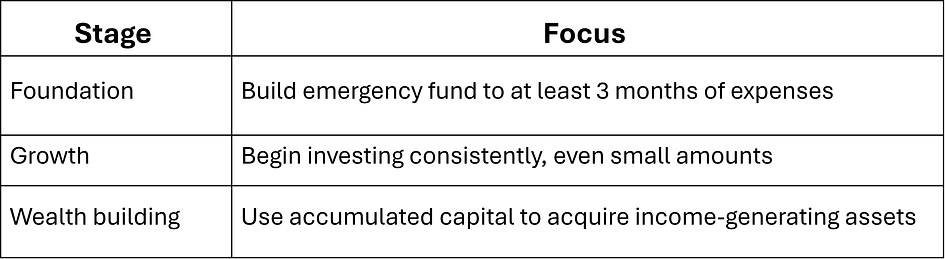
The sequence is not rigid, but the prioritisation is. Stability before strategy. Growth before acquisition.
The most common mistake
The biggest financial error is trying to look wealthy before becoming wealthy: buying assets without savings, investing without a safety net, or draining cash reserves for a property purchase and struggling when something goes wrong.
Wealth is not built through random financial decisions. It is built through structure, patience, and consistency.
Frequently asked questions
How much should I keep in my emergency fund in Nigeria? A common guideline is three to six months of living expenses. Given Nigeria’s economic volatility, erring towards six months is prudent for most individuals.
Is a money market fund suitable for an emergency fund? Yes. A money market fund offers liquidity, competitive naira returns, and low risk, making it one of the most practical options for emergency savings in Nigeria.
When should I start investing if I have no emergency fund yet? Build your emergency fund first, but you do not have to wait until it is fully funded. Once you have one to two months of expenses saved, you can begin investing small amounts alongside your ongoing savings contributions.
How do I start investing with FAAM? MyInvestar, FAAM’s retail investment platform, allows you to begin investing with structured, accessible options designed for individuals at every stage of their financial journey. You can get started directly through the MyInvestar app.